Comparative Narrative Analysis of "Life of Pi," "Slumdog Millionaire," and Nithilan Saminathan's "Majaraja."
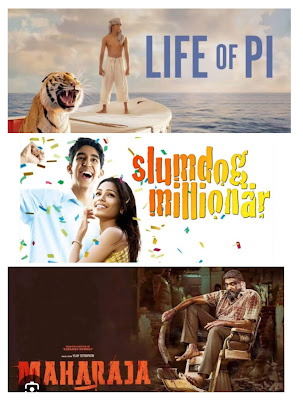
Hello. This blog is the part of studio activity of the unit An Introduction to the film studies by Dilip Sir. In this blog comparative analysis will be made of the narrative frames in "Life of Pi," "Slumdog Millionaire," and Nithilan Saminathan's "Majaraja."
Teacher's blog Befor diving into the movies let us briefly understand what is frame narrative.
Frame narrative is also known as sandwich narrative and intercalacation. According to the Oxford dictionary, "A story in which another story is enclosed or embedded as a ‘tale within the tale’, or which contains several such tales.
Prominent examples of frame narratives enclosing several tales are Boccaccio's Decameron (1353) and Chaucer's Canterbury Tales (c.1390), while some novels such as Mary Shelley's Frankenstein (1818) and Emily Brontë's Wuthering Heights (1847) employ a narrative structure in which the main action is relayed at second hand through an enclosing frame story." (“Frame narrative”)
Life of Pi :
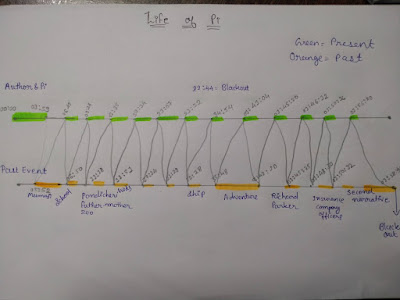
This film often employs a non-linear narrative with flashbacks and multiple perspectives (real (may be the story told to the officers) vs. imagined( the story told to author) ). The use of symbolism(animals), religious themes(which way of religion is better ? ), and philosophical questions like "Is there God " can engage the audience on multiple levels.
Life of Pi is a movie where the story doesn't go straight from start to finish. It jumps back and forth in time. Sometimes we see what happens in the present, and then the movie shows us something that happened earlier. This makes it tricky to figure out what's real and what isn't. The story is mostly told from Pi's point of view, so we see everything through his eyes. But there's another part where he contradicts himself, and they question if what Pi says is true.
For example, in the present time, Pi tells the story of how he survived with Richard Parker but did not directly jump to that. Instead, he began by telling his parents' story. After 15 minutes, the shift occurs to the childhood story, which begins chronologically. It is at exactly 22:32 that the adventure story begins, where Pi, as an unreliable narrator, retells his story. From 35:48 to 01:48:30, the main narrative of the movie takes place. The past is made more complex through the use of montage, zooms, and wide angles. Essentially, the film employs two timelines: one from Pi's life and the other from the present, where the author is asking questions.
Slumdog Millionaire:

This film uses a frame narrative structure, interweaving the present-day game show setting with flashbacks of the Jamal's life. The rapid-fire question-answer format creates suspense and drives the narrative forward. The film's core narrative revolves around a young man, Jamal Malik, participating in a television game show, "Who Wants to Be a Millionaire?" As Jamal answers each question correctly, the film intercuts with flashbacks depicting pivotal moments from his life that provide the answers.
Like the answers take the audience to some event in Jamal's life. For example, the first question's answer showcases the mad love for Bachchan. Similarly, the complex questions like "Who is there on the note of a dollar?", "Who is the founder of the revolver?", and "Who sang a Bhajan?" The film's narrative is primarily told from Jamal's perspective, offering an intimate look into his challenging upbringing and the events that shaped him. While the game show serves as the primary frame narrative, the flashbacks delve deep into Jamal's life, exploring themes of love, loss, friendship, and resilience.
The recurring motifs of the slums, the train, and the separation from Latika contribute to the narrative's emotional impact. Apparently, the story is divided into three parts: the present moment where Jamal is in the police station, second on the TV show "Who Wants to Be a Millionaire?", and third is a distinct, nested narrative of Jamal. Overall, it provides a sense of connection with the distinct incidents of Jamal's life and continuity woven within it. Each narrative meets at the middle narrative of Tv show.
While studying the narrative one is bind to find the loop halls.In the movie the heart changing of the characters made the turning point of it. Especially in the case of the police while reaching the conclusion that Jamal is innocent his heart is changed. Moreover, This movie particularly is a “Feel Good” effect movie which means if we look at the Indian history of the time then the political scenario of India was different.
Everywhere the slogan of “Viksit Bharat” is spreading and that’s why directors may choose to showcase good people. In the deconstructive reading of the movie we found more loop halls. For example, postcolonial reading of the movie shed light on the reality of the director deliberately portraying foreigners as good characters. Apparently if someone looted the car and stole all the things including wheels of the car then no one would be in that state of mind that they will give money to the child. On the contrary the foreigners are doing.
One more reading would be in the ending part where the movie director used the close up shot to see the Victoria station which is now known as the Chatrapati Shivaji station, to show Britishers as the constructors of India. Once again the colonial mindset as ruler and civilized reflected.
Maharaja :
Maharaja is a 2024 Indian Tamil-language action thriller filmdirected by Nithilan Swaminathan, who co-wrote the script with Raam Murali. A barber seeks vengeance after his home is burglarized, cryptically telling police his "lakshmi" has been taken, leaving them uncertain if it's a person or object. His quest to recover the elusive "lakshmi" unfolds. However, this film is all about "Art of editing."
Bhuvanesh in his article said, "There is an effort to play on the audiences’ minds by juxtaposing timelines, and a specific object becomes a motif to pivot the story around there’s a trash can in Maharaja that is meant to pose a question: just because you deem something useless, does it lose its value?" (Chandar) The flashbacks meant to piece things together. This world and jumps across timelines, while also plotting some set-ups and pay-offs; like a shot featuring Varadharajan’s family or when Maharaja takes leave to go shopping, only for the shop to be just opposite his house.
"All the effort to withhold information and create tension comes with a sudden turn of events written for a specific reaction from the audience." As we have earlier seen that it's all about nested narrative and the aim is to create a tension, and may be doing experimenatation. Maharaja could have been a very straightforward or ‘we know what's in store’ film for the audience if it was plain sailing. But the manner in which the story has been told has unquestionably made all the difference.
The violence against the female is used here to portray the character of villens. The violence with Jothi which is reveled at the 01:12:58 makes it intense. Now what could be the purpose of puttin g this at last is obvious creating sense od looming danger. While on the surface it is just story of lossing object but the final repetation at this timeline revels real incident. It is the moment where audience is on their pick to connect all the previous dots.
The disjointed timeline created an atmosphere of confusion, which can be attributed to a misguided attempt at imitating Christopher Nolan. But that was not so. The absurdity of his obsession with a dustbin is a stroke of genius when at 22:08 in the police station he started telling the story.
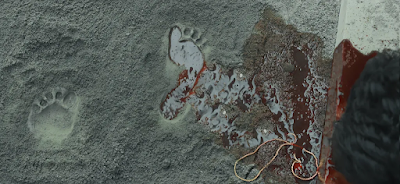
The final scene, with Selvam’s blood on Jothi’s footsteps imprints on the cement, is a powerful visual metaphor for the indelible mark his actions have left on her life. Philomin Raj’s editing deserves high praise as he navigates the non-linear narrative, ensuring clarity even with the jumping timelines. The last 20 minutes of the film are particularly intense.
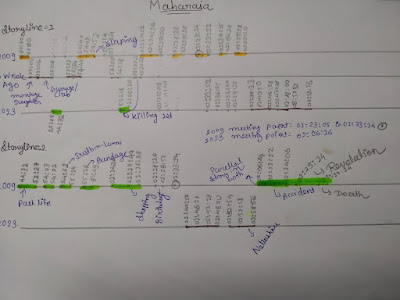
Moreover, in these last 20 minutes, the audience makes sense of earlier disjointed shots. In 2009, the meeting point of Maharaja and Shelva is at 01:33:28, and in 2023, it is at 02:06:16. Both points are important because in 2009, the seeds of revenge were sown due to a misunderstanding. On the other hand, the 2023 meeting point turned out to be the ripening of that seed.
Still, the non-linearity leads to some looming questions: Why did the dustbin reach Shelva's home? Why did Maharaja stay at the police station? These questions are answered when the audience connects the dots that the dustbin Laxmi actually belonged to Shelva. And Maharaja had the clue that the next item was at the police station, so he was there. After a long time, the audience understands why Maharaja deliberately touched every police officer's back.
As Aristotle said, the best plot would be that which is based on the cause and effect situation, and on the law of probability and possibility. In this case movies have the least accident and interference of godly elements. The character must be destiny.
In the Maharaja movie the central event is based upon the accident. This is not based upon the cause and effect. Yes, this provides cause for future events. The good plot is that in which the characters are not having sudden shifts.
For example, in the movie the heart changing of the police officer who was earlier corrupt is loose plot. However, catharsis only happens when the evil character is punished by the protagonist so violently. The camera is the language close-up shot on the receipt of toll tax played pivotal role in the movie.
With the help of this receipt Maharaja found out the vehicle and as consequences of it he found Dhana. Another important symbol is snake which came in the house once again appears in the police station that means remained rapist could be there. Additionally, as Nallashiva has habit of making noses his facial expression reveals his character as snake.
Master Frame :
“The best teachers are the ones who show you where to look, but don’t tell you what to see”

In this part, the differentiation would be made. The actual story begins from Shelva's past at 44:32. The burglary scene is the starting point, then after the birthday party scene at 01:17:17, it gives another push to the story before the first frame of the accident. From the accident, the audience jumps into the present time with Jothi's narrative from 07:00 to 18:06. The camp of the daughter and then the main climax of the story of rape and violence against Jothi occur at 01:52:58.
This is the point where Shelva's story once again gets connected. Until then, there is no clue about the story, and then the reason for coming to the police station comes at 22:08. The investigation proceeds, revealing the backstory of the killing of the first member from Shelva's team, the making of the dustbin, the revelation of Nallashiva, the killing, and finally, the heroic fight between Maharaja and Shelva.
At 02:15:14, the main revelation happens that Jothi is Shelva's daughter, Ammu. This is the zenith point of the story, which leads to another flashback. At the end, Shelva dies.If we look at this story linearly, then there is nothing new in it. But what makes it exceptional is the art of nonlinearity.
What if the story is not presented like this ?
As earlier said, this is the art of editing and nonlinearity. If there were a chance to tell the story differently, then it would be harder to find loopholes in the movie. Another observation (personal observation) is that while watching this movie, 1 out of 5 people is able to guess that Jothi is Shelva's daughter. (Probably I am not that one.) So, there is one loophole about this. Another way of telling the story would have been to include a more extended narrative about how the police know that Maharaja is not doing this for Laxmi but for Jothi. This was too small and should have been stretched more.
Conclusion :
Life of Pi, Slumdog Millionaire, and Maharaja are all movies that play with time in interesting ways. Life of Pi jumps back and forth between the present and the past, making you wonder what's real and what's not. Slumdog Millionaire also jumps around in time, but it does it to show how the main character's past made him who he is today. It is more about the prrof of today's Jamal.
Maharaja is similar to Slumdog Millionaire in that it goes back and forth in time to tell a story of revenge. However, Maharaja is more confusing because it has many different storylines happening at once. While all three movies use time in clever ways to tell their stories, Maharaja is the most complex and hardest to follow.
References :
Barad, Dilip. “Dilip Barad | Teacher Blog: Film Studies: An Introduction.” Dilip Barad's Blog, 12 September 2021, https://blog.dilipbarad.com/2021/09/film-studies-introduction.html. Accessed 28 July 2024.
Chandar, Bhuvanesh. “'Maharaja' movie review: Vijay Sethupathi stands out in Nithilan Saminathan's almost-there thriller.” The Hindu, 14 June 2024, https://www.thehindu.com/entertainment/movies/maharaja-movie-review-vijay-sethupathi-stands-out-in-nithilan-saminathans-almost-there-thriller/article68288795.ece. Accessed 29 July 2024.
“Frame narrative.” Oxford Reference, https://www.oxfordreference.com/display/10.1093/oi/authority.20110803095832133. Accessed 28 July 2024.
Radhakrishnan, Roopa. “Maharaja Movie Review: An engaging but engineered film that works even with faults.” Times of India, 14 June 2024, https://timesofindia.indiatimes.com/entertainment/tamil/movie-reviews/maharaja/movie-review/110948075.cms. Accessed 29 July 2024.


